




Every successful individual and team in the data center industry operates with a sense of urgency. Balancing this sense of urgency is heightened awareness. You constantly calibrate the impacts of every decision, indecision, action and inaction. You need to move fast, but every detail along the way has to be right, every point has to be validated, every element has to be perfect. It’s what makes every little thing you do so important in its contribution to this whole big thing called digital infrastructure.
Digital infrastructure is a composition of product (aka critical equipment). Whether your role is part of an owner-operator, wholesale developer, engineering consultant or power skid integrator, product is a unifying factor in your day-to-day work. Design, engineering and construction teams use products to compose critical systems into the harmony of an operational data center. Vendors are in the business of innovating and manufacturing product for power, cooling, networking and racking. Design and build teams are constantly contributing to and depending on product at various stages of data center lifecycles, supply chains and development.
Perfection is the outcome you and your teams need and depend on across every element of the work you do, especially for product. What happens if one detail is missed on and order for equipment that took 32 weeks to arrive? What happens is definitely not something you or anyone wants to be dealing with. Perfection is the outcome mission critical environments demand. Yet the process for how the work gets done as it relates to product (and other things) is nowhere near perfect.
Data center teams work in process and collaboration structures that focus on efficiency but often lack effectiveness. It’s time to leverage a method that concentrates on effectiveness. Doing so will simplify execution and eliminate “the confusion between effectiveness and efficiency that stands between doing the right things and doing things right.”
"There is surely nothing quite so useless as doing with great efficiency what should not be done at all. Yet our tools ... all focus on efficiency."— Peter Drucker in Harvard Business Review (HBR), Managing for Business Effectiveness
Having some of the best-run companies in the world, the data center industry invests in the best software tools and hires the best people. Yet the process for how these great people get to decisions or take action has been long outdated. Decades of digital transformation have brought teams and information ‘closer’ than ever. Even though we’re all more ‘connected’ that doesn’t mean it’s practical, useful, or works as effectively as it seems. Just ask the people doing the work.
Meetings, emails, texts, calls and collaboration platforms are how teams typically move critical product work forward. Whether you are the end-user, the specifier, or the vendor, your purpose in any one of these interactions is to inform, understand, or decide. However, the overwhelming majority of these interactions often becomes securing information, aligning expectations, validating specs, or rebuilding context. Think about how many of these interactions it takes before you have everything you need in front of you to be able to make a decision or take action. And how long of a time often lapses between initial need and final decision or real action?
“Shortening the distance between information-gathering and decision-making is critical for businesses looking to gain a competitive edge...”— Forbes, Business Agility: Bridging The Gap Between Critical Data Gathering And Decision-Making
In an article on Innovation, Forbes reports “the next frontier in enabling smarter decision-making is the ability to integrate data from multiple sources.” This speaks to data bits and bytes, but you know this concept also applies to actionable information. Data center teams constantly pour their effort into getting and integrating information from multiple sources so that it can ultimately become actionable. Stakeholders often know what they need at the start, but it’s not on-hand or easily accessible, causing teams to spend significant energy and effort bridging the gap between first awareness and being able to take action or make a decision.
It should not be so hard to get qualified, validated, coherent information to make decisions. It should not be a thing that shared understanding (aka institutional knowledge) is buried in email strings, text messages, meeting transcripts, collaboration platforms, or human memories. It’s ‘all there,’ but it’s scattered, disconnected and hard to get to when you need it. For critical equipment being such an important factor in the data center industry, nobody, no tool, no group ever usually owns the full context end-to-end.
“The chains of habit are too light to be felt until they are too heavy to be broken.” — Warren Buffett
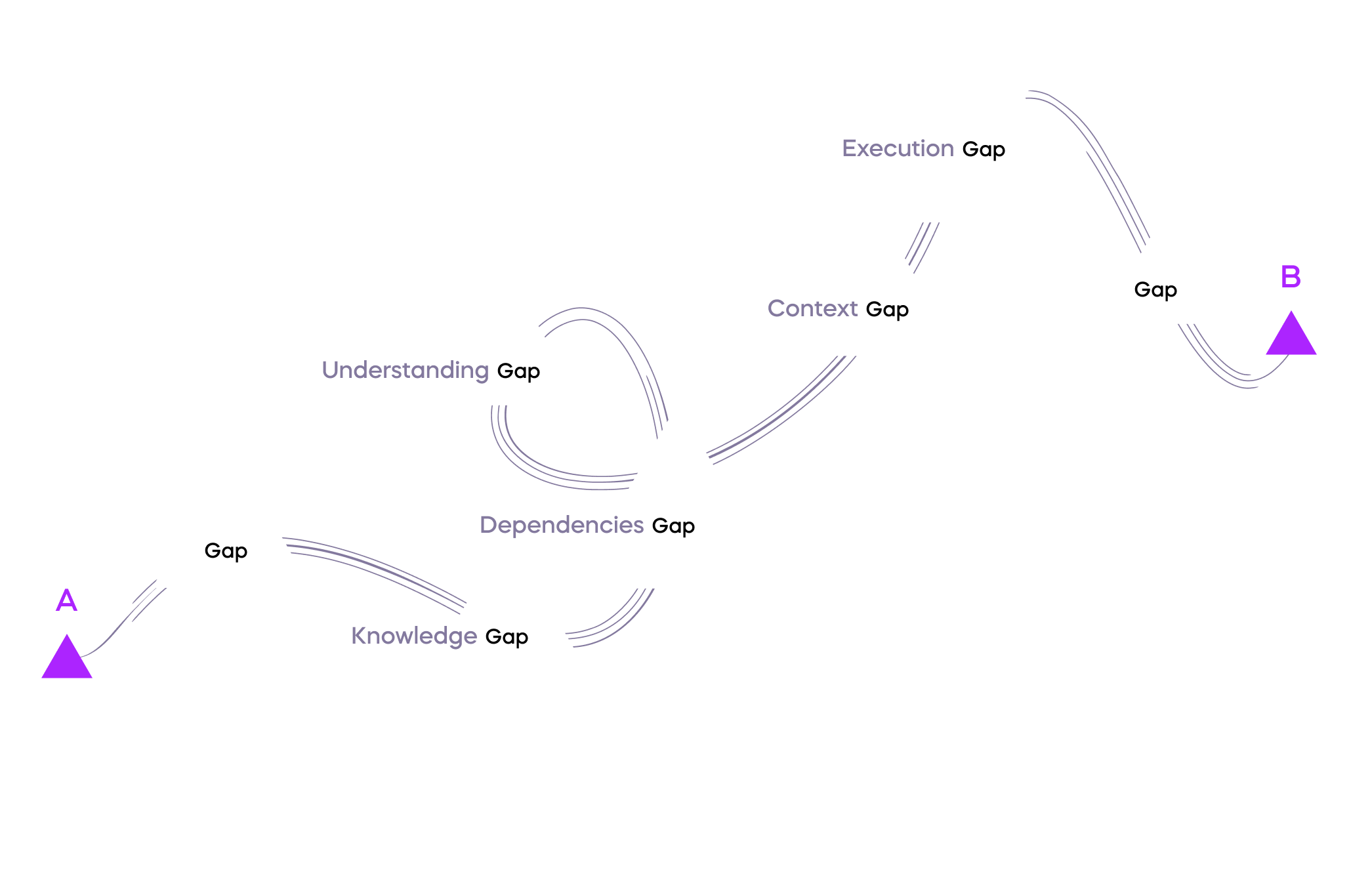
Data center teams are always filling gaps. Gaps in knowledge. Gaps in understanding. Gaps in dependencies. Gaps in execution. Gaps in context. You cannot afford for anything to not be right. So, you bounce around. Jumping between tools, meetings and stakeholders to clarify intent and fill gaps, always striving toward the invaluable quality of clarity. Data center equipment specifiers, vendors, end-users, consultants and builders are caught up in the same operating mode as the rest of the business world. Without realizing it, high-value teams in complex operations are constantly playing catch up.
Data center people (some call them ‘talent’) are among the most capable and in-demand individuals on Earth. You are the people who own critical decisions, take critical action and need perfect outcomes. Only when decisions are made does any real progress happen. You know this! Equipment isn’t specified, goods aren’t ordered, product isn’t delivered, and data centers do not get built until decisions are made and action is taken.
What if you started preventing the gaps altogether?