




Data center design, engineering and development is the ultimate team sport. Every level of progress relies on top-tier collaboration to achieve perfect execution. World-class accountability is table stakes, setting the expectation for every detail in every interaction. Each new design brings new opportunities. Each new build brings new challenges. Change is an always dependable constant throughout it all. The other constant is critical equipment (aka product). Data centers need systems of equipment and gear to perfectly fit, mate and interconnect in order to create the ideal ecosystem for servers to function.
To bolster integrity and accelerate execution, design and build teams leverage ownership and expertise. This allows data center owners and developers to focus on what they do best and partner with external firms for the rest. Construction or real estate and development teams own delivery and project management. The architects own the plan. Design engineers and PE consultants own engineering integrity. Owner’s reps own advisory and coordination between the GC, owner teams, consultants, equipment vendors and subcontractors. The GC owns making sure the building is built to plan and AHJ inspections pass.
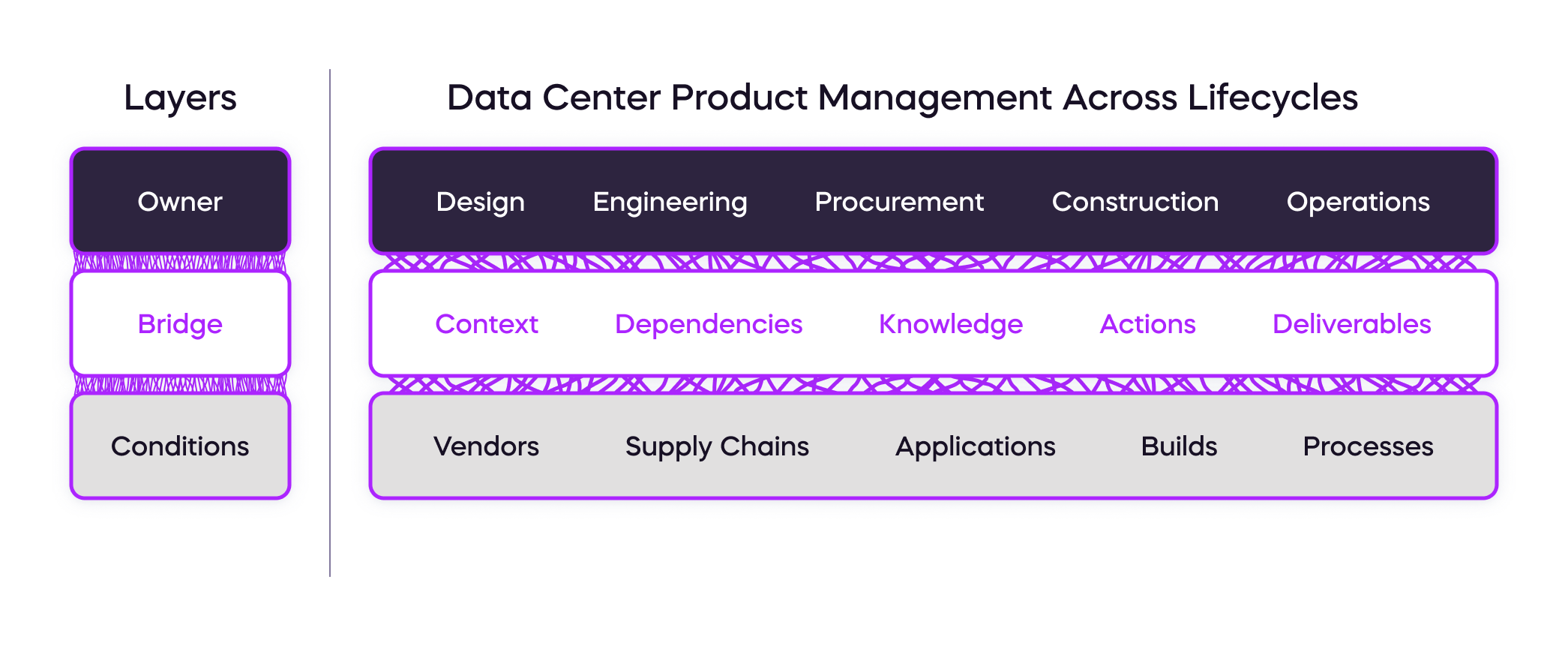
So, who owns product management? You know, the function that designs and engineers the hyperscale ecosystems of interconnected power, cooling, networking and racking infrastructure. It enables the live operations servers live within after the building is built and manages the equipment retrofits as global digital services evolve. Product management is the operational constant that deals with navigating every little change across lifecycles of designs, systems and use-cases.
Internal design and engineering teams usually own the ideas, specs and decisions for critical equipment systems. But there’s much more to product management. Product management needs bridge-builders through design lifecycles and complex supply chains. Product management requires managing every piece of information, every critical action, every deliverable and every little detail across each idea, spec and decision, as they evolve. Effective product management through lifecycles requires execution with continuity from concept to completion across vendors and applications.
“The details are not the details. They make the product. The connections, the connections, the connections.” —Charles Eames, one of the most influential American architects and designers of the 20th century
The critical path in every hyperscale build frequently finds itself dependent on something having to do with critical equipment. These dependencies are usually due to gaps in coherence, context or execution. Gaps create risk, add hidden cost and spread inefficiency between design intent, engineering use cases, dependencies, deliveries and operational flow. Beneath the surface, you will often find that a very simple thing got missed, was not accounted for, or wasn’t able to get done when it needed to be done.
Through most design lifecycles and hyperscale builds, product management ownership is fragmented or spread across various groups. For most design and engineering teams carrying this burden, their biggest daily challenge is often getting to the point of being able to make decisions or take action. Instead of driving innovation, they are overloaded with repetitive requesting, alignment, coordination and validation exercises. The very teams tasked with owning data center innovation have gotten stuck on the wrong side of the 80/20 rule.
Heavy reliance on design and engineering teams to move work forward on critical builds has forced them to put aside their most valuable realm of expertise. As with all else in data center design and development, everything having to do with critical equipment demands top-tier collaboration through countless interactions. Without clear and continuous ownership for bridge-building product management activities, gaps are guaranteed to cascade across designs and builds.
“First, out of clutter find simplicity. Second, from discord make harmony. Third, in the middle of difficulty lies opportunity.” — John Archibald Wheeler, Quantum Physics Pioneer, giving his observation of how Albert Einstein worked
Data center leaders realize the value of expertise and ownership, especially from outside firms. “The outsider who by virtue of being an outsider understands the situation of the insider better than any inside.” This conclusion drawn by Wheeler explains how Einstein was able to achieve such extraordinary results. It is also one way of explaining the value data center leaders put on leveraging outside expertise.
Enter the product lifecycle partner, the external firm now owning continuity through critical equipment lifecycles with design, engineering and construction teams. As a service, product lifecycle orchestration has become a function of emerging focus for hyperscale owner-operators, developers and vendors looking to execute faster, prevent risks, reduce hidden costs and gain effectiveness while navigating constant change. Product lifecycle orchestration delivers clear, consistent information, actions and deliverables for teams that contribute to and depend on critical equipment.
As with other data center consultants that support hyperscale design, development and retrofits, the product lifecycle partner is an expert-led service. Think of a product lifecycle partner as an ongoing orchestrator. They steward vendor processes and own simplifying the volatility of change that surrounds critical equipment. An effective product lifecycle service offers one cohesive solution across vendors, applications, teams, designs and supply chains. Without this holistic approach, critical elements can easily get lost or left behind between designs, builds and operational initiatives.
Their continuous involvement through design and engineering iterations before, during and after builds is a primary differentiator between the product lifecycle partner and other data center consultants. This focus adds invaluable continuity to constantly changing context, dependencies, decisions and institutional knowledge. In this model, design, engineering and construction stakeholders are able to collaborate and make decisions more effectively with clear information and consistent actions served directly to them. Operating end-to-end, the product lifecycle partner acts as a dependable backbone to help teams move work forward. They help simplify the execution in each lifecycle phase of critical equipment design, onboarding, delivery and deployment.
“Eventually everything connects – people, ideas, objects. The quality of the connections is the key to quality per se.” — Charles Eames
This long-needed service for the data center industry is producing measurable and immediate impacts to design, engineering and construction teams responsible for getting work over the line. In hyperscale environments filled with constant change, owner-operators, developers and equipment vendors are shortening decision cycles, accelerating decision-making, preventing on-site issues and eliminating rework.
Give continuity to the micro work. Create macro impacts.